Designing Ambient Interaction for Calm Domestic Experiences
Individual Project | Interaction Design & Client Project
Interaction design and prototyping, Iterative development and refinement,
3D modeling and design for housing, User evaluation and feedback analysis
Duration: 2 months (2026)
What is this?
How can ambient interactive systems create meaningful engagement without demanding attention?
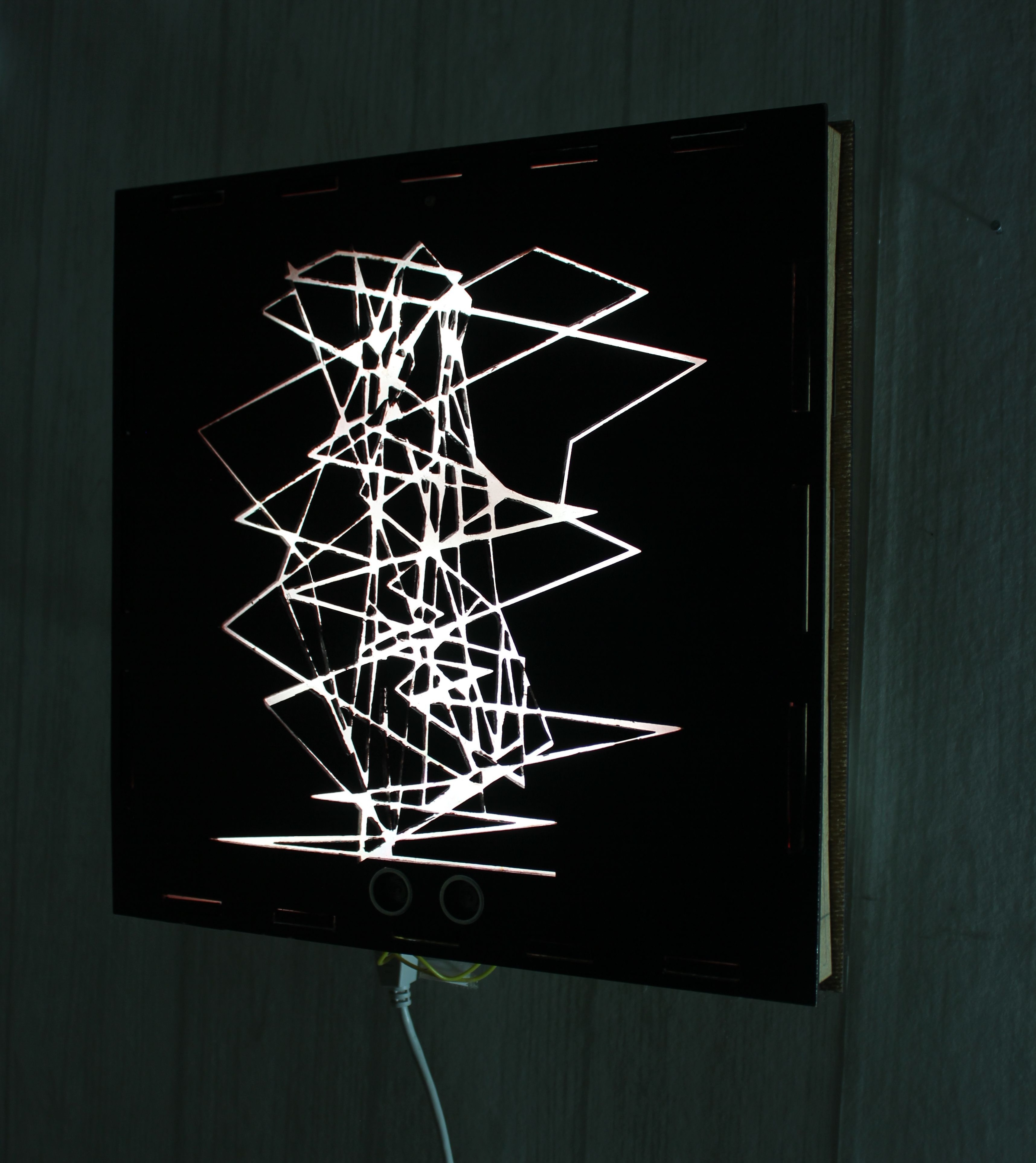
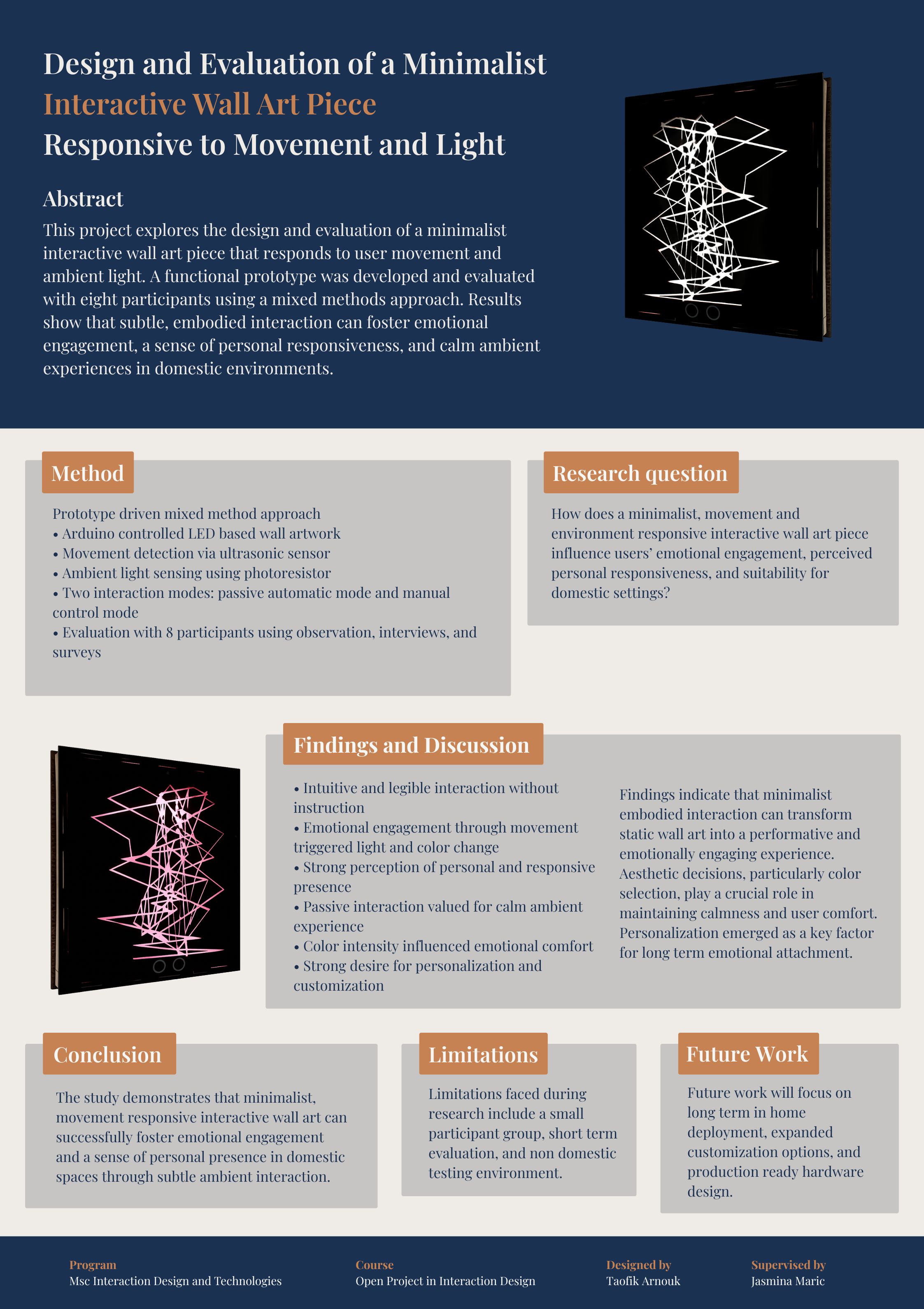
Designing Ambient Interaction for Calm Domestic Experiences is a responsive ambient installation that transforms static wall decoration into a subtle, performative experience.
It explores presence-based and environmentally adaptive interaction to foster emotional engagement without explicit input.
Rather than relying on direct manipulation, the piece responds to movement and surrounding light conditions, creating a calm and embodied interaction where the artwork appears to notice and react to a person’s presence.
This approach fosters quiet responsiveness and personal connection within domestic environments.
Visually, the design draws inspiration from a fragment of Gaussian-Quadratic by A. Michael Noll, translating early computational art into a contemporary interactive wall-based experience.
How does it work?
The system is designed around two complementary interaction modes that balance passive responsiveness with optional user control.
In its primary mode, the interaction is implicit. Movement is used as a form of passive input, allowing the system to respond without requiring intentional action.
An ultrasonic sensor detects presence, while a photoresistor continuously adapts the light intensity based on ambient conditions. This enables the artwork to
remain context aware, becoming brighter in darker environments and dimmer in well lit spaces.
This interaction approach was chosen to reduce cognitive load and avoid demanding attention, allowing the experience to remain calm, peripheral,
and seamlessly integrated into everyday life. An early design decision was to avoid direct interaction (e.g. buttons or touch as primary input),
as this risked turning the experience into a task rather than an ambient presence.
In a secondary mode, users are given more direct control. By activating a physical button, automatic brightness adaptation is disabled, and a side mounted
potentiometer allows manual adjustment of light intensity. This introduces a balance between system autonomy and user agency, supporting both passive
and active interaction styles.
The overall behavior of the system is guided by a core design principle of subtle responsiveness, where interaction emerges through presence and environmental
context rather than explicit commands.
Design Principles
- Subtle Responsiveness: Interaction occurs through presence and environmental changes rather than explicit input, reducing the need for attention.
- Peripheral Interaction: The experience is designed to remain in the background, allowing users to engage passively without interruption.
- Calm and Ambient Behavior: Light transitions and responses are intentionally gradual to avoid overstimulation and promote a sense of comfort.
- Balance of Control: The system supports both automatic behavior and manual interaction, giving users the option to influence the experience when desired.
How it was made
Ideation
- Early sketches and client discussions defined functional and aesthetic direction
- Goal: minimalist, movement-responsive wall piece reacting to environmental input, through
light and motion sensing, while maintaining a calm and emotionally engaging presence within a domestic space.
First Prototype Iteration
- Technical validation using Arduino Uno, LED strip, ultrasonic sensor, photoresistor, potentiometer, and buttons
- Housing designed in Autodesk Fusion 360, laser cut wood, and 3D-printed diffuser and control covers
- Identified uneven light diffusion, informing improvements for next iteration
Second Prototype Iteration
- Visual and ambient quality refined based on feedback
- Material and diffusion adjustments created a more even, natural glow
- Enhanced cohesion of the overall experience
Final Prototype & Evaluation
- Evaluated with 8 participants via observation and surveys
- Movement-triggered responses perceived as playful, calming, and meaningful
- Successfully balanced responsiveness with subtlety
Additional user feedback
The artwork was often perceived as personal rather than mechanical, indicating that even simple ambient interactions
can create a sense of connection.
Initial surprise transitioned to comforting familiarity over time
Some participants initially found the responsiveness unexpected, but quickly adapted, with the interaction becoming more
comforting over time. This suggests initial surprise transitioned to comforting familiarity over time.
Participants also expressed strong interest in customization, particularly in color selection, highlighting the importance
of personal preference in shaping emotional engagement and long term satisfaction.
While the system successfully created a sense of responsiveness, it remains unclear how the interaction would be
perceived over longer periods of time, suggesting the need for longitudinal testing.
View Report
Feel free to reach out for any questions