Minimalist Interactive Wall Art

Interaction Design Project & Client Project
UI Design, UX Design, Research, Usability Testing, Prototyping, Iterative Design, 3D modeling and Printing

What is this?

Minimalist Interactive Wall Art is a responsive ambient art piece designed to transform static wall decoration into a subtle, performative experience that reacts to both user movement and the surrounding light conditions. Rather than requiring direct input, the piece creates a calm and embodied interaction in which the artwork appears to notice and respond to a person’s presence as they move through the space. The project explores how minimalist interaction can foster emotional engagement, a sense of personal responsiveness, and suitability within domestic environments.

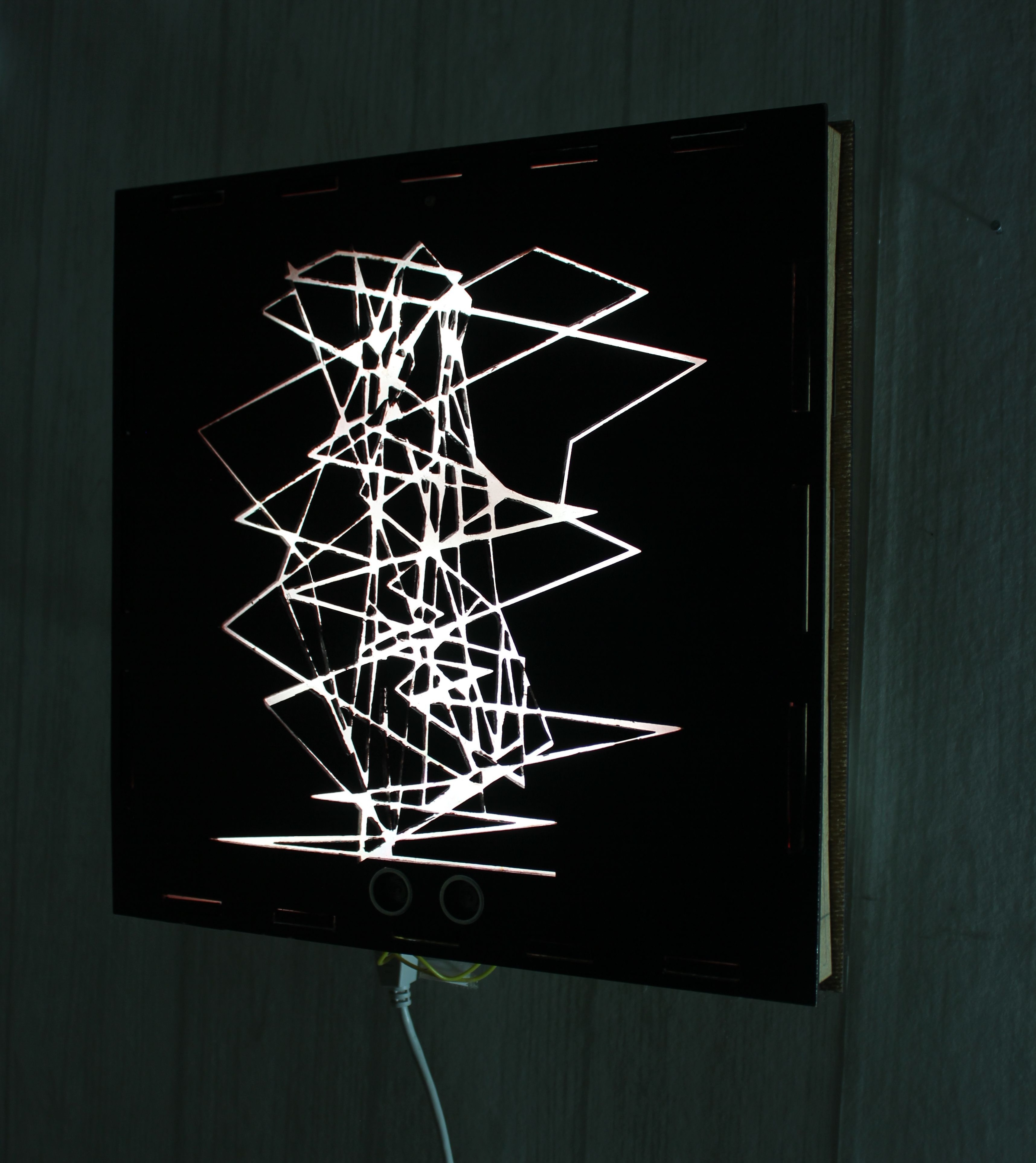
Visually, the design draws inspiration from a fragment of Gaussian-Quadratic by A. Michael Noll, translating early computational art into a contemporary interactive wall-based experience.

How does the application work?

The wall art operates through two interaction modes that balance passive responsiveness with optional user control:

In its primary passive mode, an ultrasonic sensor detects when someone walks past the piece while a photoresistor continuously measures the ambient light in the room, allowing an addressable LED strip to animate and automatically adjust its brightness by becoming brighter in darker environments and dimmer in well-lit spaces. This creates a seamless and calm experience in which the artwork adapts to both presence and context without requiring any direct user input.

In the second mode, which is activated via a physical button, the ambient light sensing is disabled and the user is instead given manual control over the light intensity through a side-mounted slide potentiometer, while movement detection remains active.

The entire system is controlled by an Arduino Uno, programmed using the Arduino IDE, and is guided by a core design principle of subtle responsiveness, where interaction emerges through presence and movement rather than explicit manipulation.

How it was made

Ideation

The project began with sketches and feature discussions with the client to define the core functionality and aesthetic direction.

The goal was to create a minimalist, movement-responsive wall art piece that uses light and environmental sensing to provide a subtle, ambient, and emotionally engaging interaction in a domestic space.

First Protoype and 3D print

The first prototype focused on validating the technical setup and interaction clarity. It was built using an Arduino Uno, LED strip, ultrasonic sensor, photoresistor, potentiometer, and buttons, all breadboarded and programmed before integration.

The housing was designed in Autodesk Fusion, laser cut from 3mm wood, and combined with 3D printed diffuser and control covers. The prototype successfully demonstrated movement triggered colour changes, automatic brightness control, and mode switching, but revealed issues with tolerances and light diffusion.

Second Iterattion of Protoype

Based on client feedback and early testing, the second iteration refined aesthetics and finish. The faceplate was redesigned to showcase more of the generative pattern and painted black for a polished, gallery like look.

The diffuser was replaced with elements on white parchment paper, reducing light leakage and creating a softer, more even glow, greatly improving visual quality.

Final Protoype

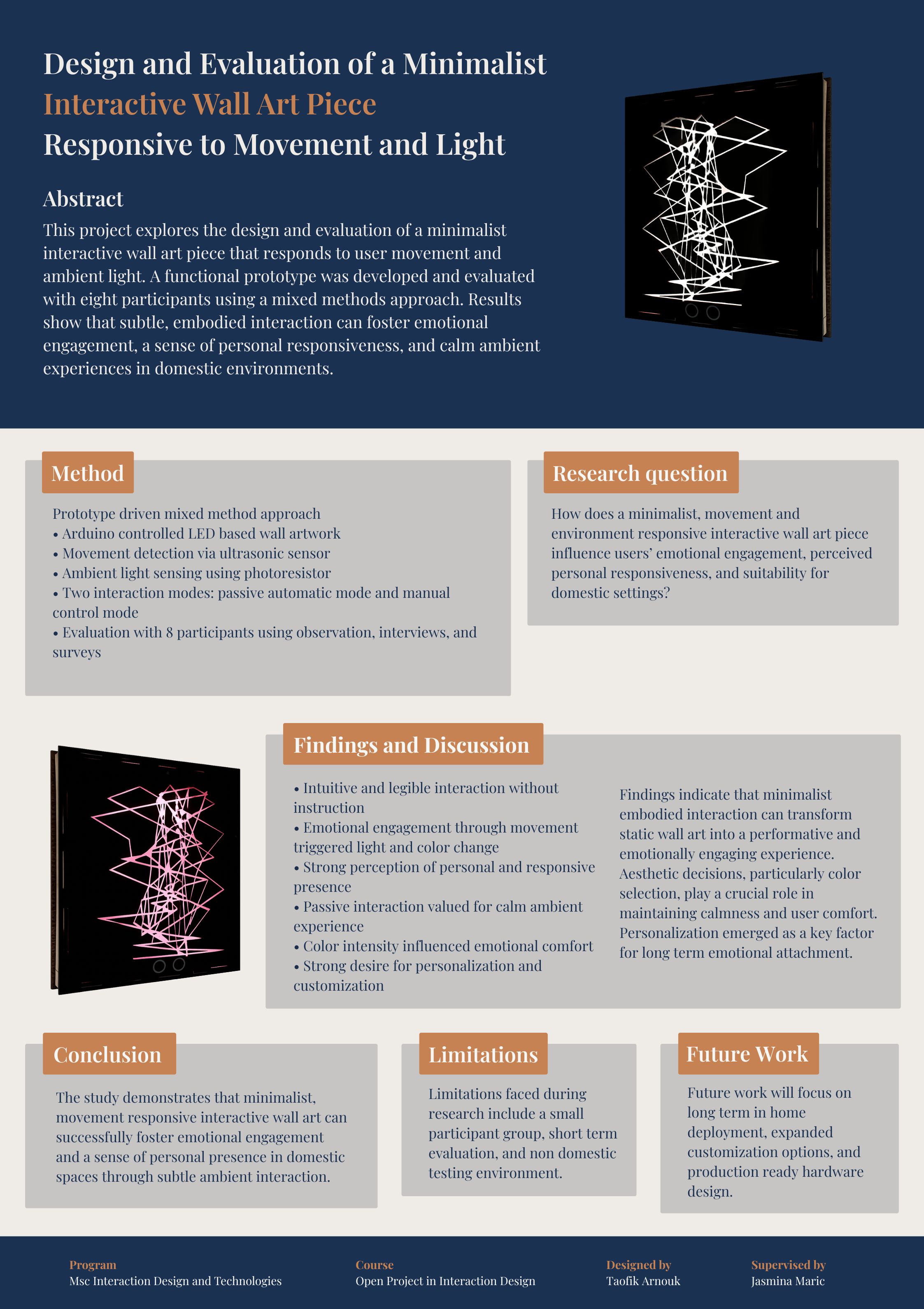
The final prototype, evaluated with 8 participants through observation and surveys, revealed that minimal interaction such as walking past felt meaningful, movement triggered color changes were playful, comforting, and engaging, the piece was perceived as personal rather than mechanical, passive mode supported calm, ambient use, and participants expressed strong interest in customization, especially color choices, which influenced emotional comfort and long term enjoyment.
Minimalist Interactive Wall Art V2 Product poster for Minimalist Interactive Wall Art